Archive for the ‘News’ Category

CELEBRATING TWO DECADES OF WORKING FOR SULGRAVE

Thursday, October 23rd, 2025

Construction of Castle Green boundary wall. November 2007.
Photograph: Colin Wootton

Martin Sirot-Smith writes:

Saturday 11th October saw, in the convivial surroundings of the Moon and Sixpence pub in Hanwell, the valedictory meeting of the Castle Green Management Committee. It was formed in January 2005 to undertake, on behalf of the Sulgrave Parish Council, the administration of the restoration and enhancement of Castle Green and later, Castle Hill. All of the original seven committee members (except, sadly, Clare Pollak) were present, plus three who joined later, to celebrate twenty years of working together.

The Committee evolved from the original Manor Field Action Group which was set up in July 2003 to secure funding for the purchase of Castle Green (Manor Field) on behalf of the village. This it did, in less than a year, raising over £30,000 from Grant Making bodies and a local appeal. No mean achievement, as recognised by the Parish Council Chairman at that time, Ken Christy. “It was an example of how much a single minded body could achieve in a very short time”.

The Committee was made up of Paul Crowley, Treasurer, Clare Pollak, Project Director, Peter Pollak, Secretary, Jo Powell, Christina Shillito and Colin Wootton who were joined in 2017 by Will Priestman, in 2018 by Richard Fonge and in 2020 by Rosie Shillito. Its terrms of reference were to restore and enhance the whole site, remembering it was a Scheduled Ancient Monument, for the benefit of both Sulgrave villagers and the general public. It was my pleasure to Chair this Committee throughout its lifetime.

Under the terms and conditions of the two main grant giving bodies, the South Northamptonshire Council and the Esmée Fairbairn Foundation, we then produced a full Management Plan and Conservation Statement, bearing in mind that English Heritage would need to agree to any projected work on the site. Later this would lead to untold problems. The work to restore the drystone encompassing wall, to provide access paths with tarmac entrances and post and rail fencing all required English Heritage permission. Also we were only allowed to use their designated contractors. This all led to long delays and when their original contractor went into liquidation, it meant starting all over again.

In the meantime we were busy fund raising. Here we were very much indebted to Clare Pollak’s industrious seeking out of grant making bodies and her skill in making good relationships with those individuals responsible for their administration. In all, grants totalling over £85,000 were raised! This enabled us to cover not only the physical works but also the installation of benches, interpretive sign boards, and nesting boxes as well as producing leaflets explaining the archaeological history of the whole site.

Special days were organised, “Field Days”, with history based Treasure Hunts for children, exhibitions, demonstrations as well as stalls and other attractions. These became a regular, much anticipated feature of Sulgrave village life.

2011 was the year that finally saw the Restoration and Enhancement Project reach its conclusion. Coming in under budget it was possible to transfer £1200 to the Parish Council to help provide for future maintenance! Since then the Committee has met regularly to organise working parties, keeping the Green well tended and ensuring problems are quickly dealt with. Events and happenings were regularly organised, bringing all ages together to enjoy what is a wonderful village amenity.

In March 2018 the chance to purchase and take into public ownership the Castle Hill site, thus bringing the whole of the Scheduled Ancient Monument under the Committee’s control and management, was gratefully taken. £6,000 was quickly raised from local organisations and from many generous donations from willing villagers. All this was done in five months, giving us enough funds to complete all the necessary remedial work needed before it, and the Castle Green itself, could now become a Public Open Space for all to enjoy in perpetuity.

The final meeting of the Castle Green Management Committee was indeed its 101st during the twenty year period of its existence! This does not include the countless site meetings, informal inspections and discussions. The superb village asset we have today is much due to the continual commitment of all the Committee members over the last two decades. It has been a pleasure to present at each Annual Parish Meeting over the last twenty years the achievements and successes of the Committee.

Martin Sirot-Smith    Chairman and Convener        Manor Field Action Group 2003 – 2005      Castle Green Management Committee 2005 – 2025

See next page for a photograph of the Committee and further information on the Castle Green and Castle Hill public open spaces.

Click on “Read the rest of this entry”.

(more…)

October on the Farm (2025)

Thursday, October 16th, 2025

Autumn Leaves. Photo: Colin Wootton

Richard Fonge writes:

We are having some lovely autumn weather. One of the many privileges of living in our country and in particular in the countryside is the changing of the seasons to appreciate. Autumn is a special season with the colouring of the leaves and its early morning mists. It is also the start of the farming year. Farms are sold and tenancies change hands mostly at Michaelmas (Sept 29th). Why is this so?. Harvest is over and next year’s crops are being planted, rams are put into the ewe flocks for spring lambing, cattle are brought in from the fields in October for the winter. So from a practical aspect an obvious starting point. When a farm changes hands the outgoing farmer usually has a sale, which includes everything from scrap metal, small tools, to machinery and livestock. Whilst these can be great social occasions for the local farming community to catch up on what is going on in the locality, to buy and support the outgoing farmer, they can be very sad times for those directly involved. I speak from the experience of two such sales, firstly at my Father’s retirement, and then my own.

Agriculture tenancies have changed and there is a greater security of tenure today, but this wasn’t so before the 1948 Agriculture Act. This was a comprehensive act of parliament which brought in financial support to the farmer through guaranteed payments or subsidies, with other payments to encourage more home grown production of food whilst keeping the cost of food down. World War 2 had brought home the realisation that we shouldn’t be dependant as an island on imports.

The act also gave tenant farmers greater security, with landowners having to go before a tribunal with good reason to end a tenancy Non payment of rent or bad farming had to be proved. Up to then a tenant could be given as little as six months notice to quit, as happened to my parents, when their landlord decided to give his newly married daughter the farm. The upside of that was we moved to Stuchbury Manor Farm, Sulgrave, where I had a wonderful upbringing in a special place and a lasting love for the area.

Richard Fonge.

“The Culworth Gang” – An illustrated talk by Richard Blacklee. Sulgrave Village Hall at 7.30 pm on Saturday 25th October.

Wednesday, October 8th, 2025

Sulgrave Club is thrilled to announce a very special speaker in The Village Hall on Saturday 25th October 2025 at 7.30pm.

The Legendary Culworth Gang featuring William Abbot, Sulgrave Church Warden and Highwayman. An illustrated talk.

Richard Blacklee, amateur historian and author gives a chilling insight into just one of the fascinating stories he has uncovered in the Northamptonshire area.

In the late 18th century, the legendary and notorious Culworth Gang, engaged in poaching, housebreaking, and highway robbery in the local South Northamptonshire area.

Most highwaymen had relatively short careers, but because of their careful planning the Culworth Gang’s reign of terror lasted for almost twenty years. However, the law finally caught up with them and they were charged with 47 robberies and other offences. Find out what fate had in store for them on 25th October and don’t miss this great speaker.

Tickets cost £10, which includes a reception glass of wine, and can be bought on-line by going to: ticketsource.co.uk/the-sulgrave-club.

The Sulgrave Club

Sulgrave Village Shop Newsletter for October 2025

Monday, September 29th, 2025

September on the Farm (2025)

Sunday, September 21st, 2025

A “Superabundance” of Crab Apples. Photo: Colin Wootton

Richard Fonge writes:

Much needed rain as summer ends and autumn arrives. Much needed because after a spring and summer of near continuous sun, resulting in a poorer harvest of all crops, it was vital that we had rain to help establish next year’s crops. Oilseed rape, needs to be sown by the end of August and grass seeds also to get good growth before winter. With a warm soil to be planted in, germination of any seed will be very quick.

I mentioned the mule ewe in last month’s notes and a good example of the breed can be seen in the field on the footpath to Stuchbury, where further on, on the parish boundary is a crab apple tree laden with a density of fruit which is quite amazing. Hedgerow fruit of all kinds are very abundant this year.

Also on that path farm yard manure has been spread over the phacelia, as it has been on the Stuchbury field over the hedge . A good healthy smell for a few days!This manure will be incorporated into the soil and along with the green manure will enrich that soil for the following crops. Manure from livestock was once an integral part of the farming year rotation, but as specialising of agriculture advanced from the mid sixties onwards, the mixed enterprise farms disappeared with many farms becoming arable only. In our area we have farms with arable, sheep and beef enterprises, but dairy farms are scarce. Most of our daily pinta is produced in the western half of the country.

We take for granted the ready availability of milk, but to produce that food, there is a lot of science, genetics and hard work. The breeding is the basis for a healthy herd to produce a quality product, with then the feeding of the cow with a balanced diet. All that is fed to the cow is analysed to meet the requirements of a healthy animal and the quantity of milk she is producing during her lactation of ten months. Milking is a twice a day task, except for those using robots, where a transponder round the cow’s neck allows her to enter the robot milker, and it is then found they get themselves milked four or more times a day.

Technology runs our lives, with G.P.S. to guide us to our destinations. But here’s a thought. The swallows leaving our telegraph lines will migrate to Africa and return next April to nest in the same place. Are we as clever as we think??

Richard Fonge

Sulgrave Produce Show, Sunday 14th September 2025

Thursday, September 18th, 2025

A Winning Entry. Arrangement of Flowers from My Garden in a Jam Jar.

The Prizes.

The Exhibits (1). Photo: Graham Roberts

The Exhibits (2). Photo: Graham Roberts.

The Exhibits (3). Photo: Graham Roberts.

The Photographic Competition. Photo: Graham Roberts.

See next page for photos of the winning entries.

Click on “Read the rest of this entry”.

(more…)

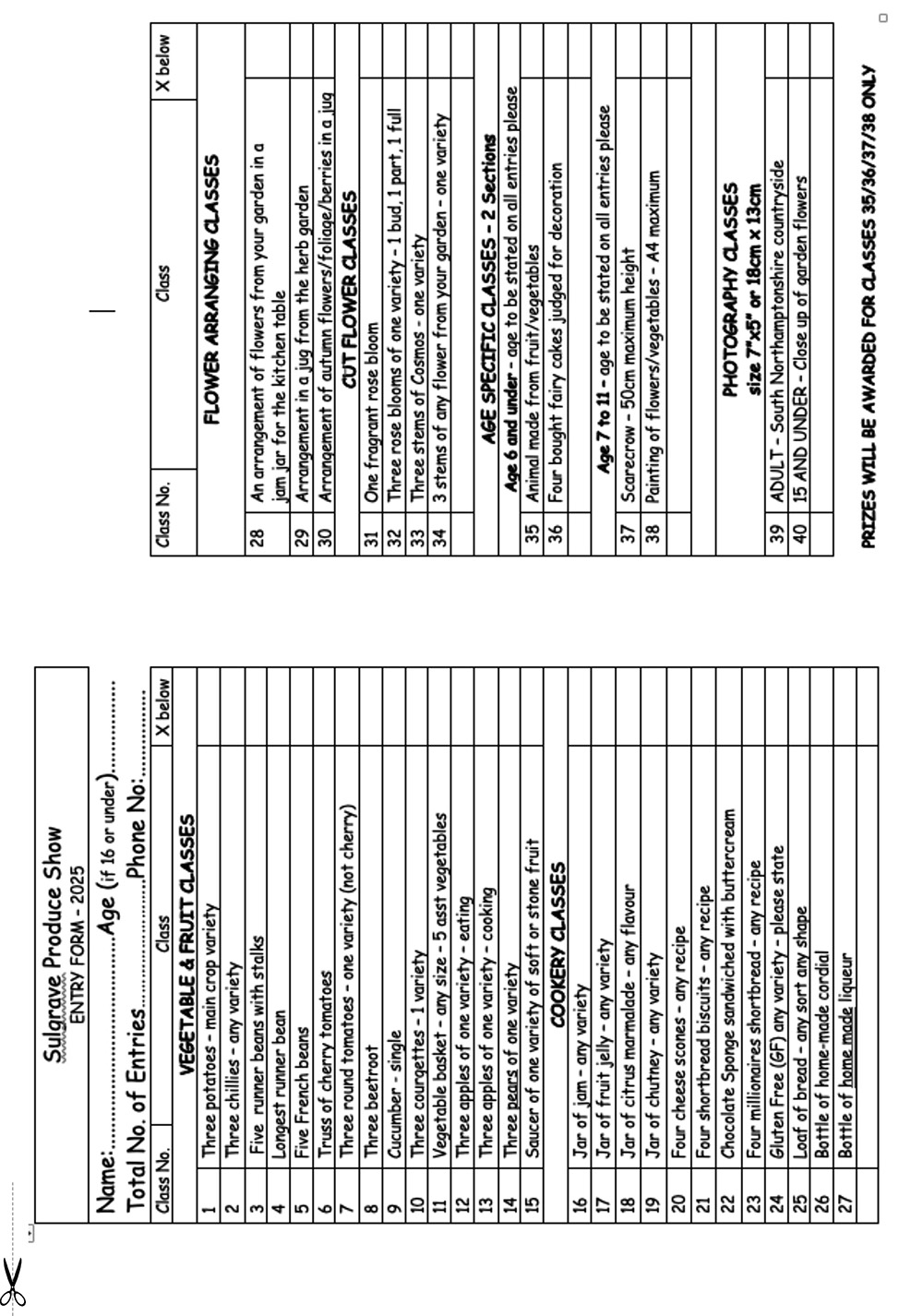
Annual Sulgrave Produce Show in the Church Hall on Sunday 14th September.

Thursday, September 11th, 2025


Download Entry Form here.

Sulgrave Village Shop Newsletter for September 2025

Thursday, September 11th, 2025


August on the Farm (2025)

Friday, August 15th, 2025

Completing the harvest.

Photograph: Graham Roberts

Richard Fonge writes:

Now the harvesting of the crops is complete, it is time to reflect on what has been an exceptionally difficult season to grow them. The lack of spring rain stunted growth, and a hot June with no rain to swell the grain has resulted in a poor harvest, with output at least 25% down in this area. It takes a look at the blackberries which are a month early to appreciate how the dry summer has impacted on their size.

The combine after threshing the corn out leaves the straw in a neat row. This too has become much more valuable this year not only for bedding of livestock in winter but as a feed. Barley straw in particular has a feed value and if molasses is added (by product of the sugar industry) it is more palatable. In areas where there is no demand for the straw, the combine can chop it up as it leaves the machine, and it is then incorporated back into the soil as organic matter.

The wild flower fields mentioned last month are still busy with bees. Buck wheat is now evident and a type of pea. I’ve picked the odd pod walking through. Tasty!

Also of interest to note is that the area sown to grass and sheep grazed a few years back, the wild white clover has returned.

A reader asked about sheep farming , so here is a brief synopsis. The majority of our breeding stock is reared on our northern mountains and moorland. The mule ewe. They are vital to the economy and the landscape of these areas. The yearling females are sold south for breeding to be crossed with a pure bred downland or continental breed, to produce a good butchers’ lamb. You have the hybrid vigour of the female and the confirmation of the terminal sire. There are many pure bred breeds also, but in the commercial world the mule ewe is often the first choice.

This time of year sees the movement of combines, tractors and balers and large loads of straw through our villages, causing problems at times. The size of agricultural machinery has increased hugely over the years but the lanes and byways haven’t. Please be tolerant, we live in a rural village surrounded by farmland where the business of farming is carried out, so this activity is all part of rural life.

Finally. Bees. A man ran out of petrol. A Queen Bee arrived, told him to open his petrol cap. Swarm of bees went in and the car started. He asked the Queen how? Reply: Filled with B.P.

Richard Fonge.

Sulgrave Village Shop Newsletter for July 2025

Thursday, July 24th, 2025